

Louie Al-Hashimi is driven by service. It started in high school, he said, when his history teacher encouraged him to get involved in community service and he began volunteering at a local food pantry, supporting road cleanup projects, and organizing school concerts for charity.
“That, coupled with my studies, encouraged me to pursue public service,” said Al-Hashimi, who earned his master’s in public administration from George Mason University in 2020. “Having the opportunity to build or facilitate a connection with other people—that’s what I’m drawn to.”

How could the U.S. have improved its response to the COVID-19 pandemic? Mason president Gregory Washington hosts CHHS epidemiologist, Amira Roess, PhD MPH, as she breaks down the many factors impacting the nation's response and recovery.

There is one more week to give your feedback for the recommendations from the Anti-Racism and Inclusive Excellence Task Force. The feedback form is open through close of business Friday, March 19.
In this month's column, Faculty Senate Chair Shannon Davis is urging faculty to attend the General Faculty meeting at 3 p.m. on Wednesday, March 17, via Zoom. This is the first General Faculty meeting since 2000 where business will be conducted, and a quorum is required.
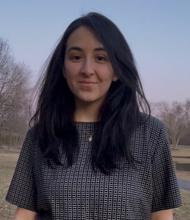
Honors College student Brenda Henriquez has been named an Adobe Research Women-in-Technology Scholar, a program that recognizes outstanding undergraduate female students studying computer science.


Allison Redlich, a professor in the Department of Criminology, Law and Society within the College of Humanities and Social Sciences, and a colleague at Central Michigan University have received a collaborative National Science Foundation grant of $385,000 to study wrongful convictions within the U.S. criminal justice system.

The eastern region of Ukraine has been an intense battleground since 2014, when Russia controversially annexed the Ukrainian peninsula of Crimea and invaded the Donbass region in eastern Ukraine. Though a ceasefire was called, it has been violated daily. More than 10,000 people have died and roughly 1.6 million are registered as internally displaced people (IDP).
But a step toward hope and peace may be on the horizon, thanks to George Mason University’s Carter School for Peace and Conflict Resolution, and their new project funded by a $50,000 grant from the U.S. Embassy in Ukraine.

Smialek, a single mother of one daughter, has been juggling parenting, teaching or going to school and her work as an Air National Guard medic for a while.